
MagVin Desk: v0-v5 Overview
Fifteen years of documents scattered across hard drives and no system on the market did what I needed. So I started building my own. Five versions later, I have a personal archive project that has become a framework for building anything.
MAGVIN DESK
Lance
11/19/20254 min read
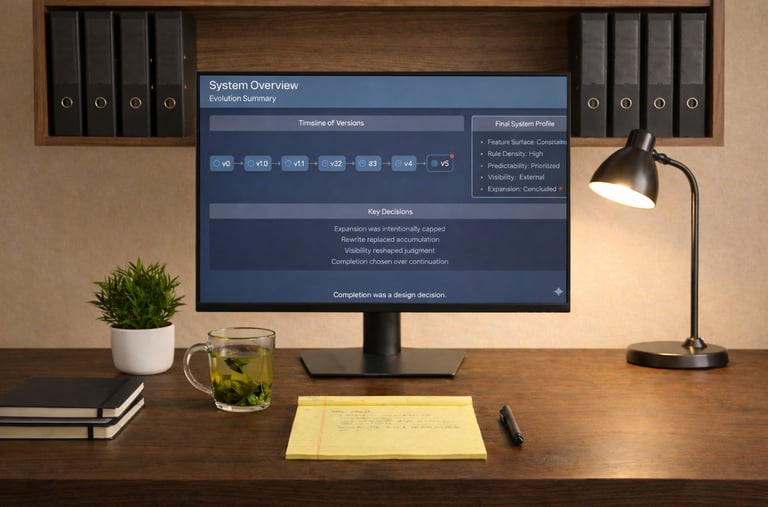
Building Judgment
I see the opportunities AI will create in the near future. It is not a tool for the technical few but a transformation as significant as the spread of the internet, when access to information shifted from privilege to expectation. That shift changed how people learn, work, and make decisions. The next shift will change how people think, because the tools that synthesise and analyse at scale are no longer reserved for institutions with dedicated infrastructure. They are becoming available to anyone willing to learn to use them, and I want to be positioned for that future rather than watching it unfold.
I also had a problem worth solving. Fifteen years of documents sat across my drives: financial records, medical files, contracts, and correspondence accumulated over a career spanning three continents. The information existed but was not valuable because it could not be searched, compared, or analysed. I needed a system that could ingest scanned pages and digital files, extract their contents, and make them retrievable. Nothing I found met my needs, so I decided to build it.
I am not a coder. I arrived at this project as someone who had spent fifteen years in academia developing curriculum, designing assessment systems for global audiences, coordinating programs, and teaching innovation and entrepreneurship. I had worked as a banker, managed teams, and learned that precision and structure transfer across domains even when the tools change. I hold myself to a standard of doing things right, and that standard does not soften when the environment is unfamiliar. It just requires different methods to meet it.
The Build
The first version began the day dedicated hardware arrived: a PC with enough power to run language models locally, process documents in bulk, and extract text from scans at scale. With the constraints removed, I built everything in one go, creating a complete document-processing system with dual OCR engines, automated workflows, and an interface where I could monitor files moving through the pipeline. The ambition felt appropriate because I could finally see the whole system working together instead of assembling disconnected pieces.
I quickly learned that adding more features did not improve capability. The system could process documents, but each addition made it harder to understand what was happening under the surface. Crashes wiped out hours of progress because the system could not resume interrupted jobs, and quality degraded silently when one engine failed, and another took over without notification. I had built something powerful while losing control of how it actually worked.
The second version tried to solve those problems by adding more options. I integrated additional OCR engines and built a content router that let text-layer documents skip OCR entirely, preserving perfect accuracy while saving significant processing time. But the deeper architecture continued to struggle, and the codebase grew to nearly fifteen thousand lines in a single file. I could justify every feature individually, yet collectively they had become unmanageable.
I understood the warning signs, but I also understood I had not yet built the framework to respond to them. The gap between what I had created and what I could confidently maintain was widening with each addition. The limitation was not technical. The limitation was clear: my own decision-making. I had been approving every idea without first checking whether the system could accommodate it.
I stopped building and started writing. Quality matters more than speed. Accuracy matters more than speed. Fidelity is paramount. These were not aspirations but rules that would govern every decision moving forward, and I wrote them down before I wrote another line of code.
The Discipline
The third version began with deletion. I cut sixty-eight percent of the codebase, collapsing the architecture to only what was essential. The four-engine stack dropped to three, and entire subsystems disappeared, but what remained was lean, focused, and finally manageable.
I ran a benchmark against documents that had justified the earlier complexity: handwritten notes, low-quality scans, and mixed-language contracts. The simplified system achieved ninety-seven percent success, and the lesson could not have been clearer: the system that did less accomplished more. Everything I had spent months overbuilding could have been this simple from the start.
The fourth version built on that foundation by restructuring the codebase into separate modules and running engines, including teh stored PaddleOCR, in isolated environments so dependency conflicts could not destabilise the rest of the system. Isolation worked, and the system ran continuously without crashing while I processed large batches overnight with confidence. But the architecture revealed a new limitation: virtual environments solved the dependency problem on my machine, but remained fragile when reproduced elsewhere. The system worked locally but could not travel.
That realisation opened a different question. I built this for my own archive, but the problem it solved extended beyond personal use. Instead of building further, I paused to assess whether the opportunity was real or whether I was projecting my own needs onto a market that did not exist.
The fifth version never became code. It lived as architectural plans and market research, while I designed container-based deployments, planned database upgrades, and mapped interfaces for broader access. The research was conducted in parallel to examine what commercial deployment would require.
The research revealed both validation and sobering findings. The need was genuine, but the scope would require a team, extended timelines, and operational capacity I could not sustain on my own. Then Google released Gemini File Search, and the calculation shifted entirely. Their product validated the market while simultaneously removing the urgency, because cloud providers could deliver the core capability at scale, which I could not match as a solo builder.
I chose discipline over persistence. The research had done exactly what research should do: it exposed constraints before I built something the market would have undermined regardless of execution quality.
What Emerged
Five versions. Three complete architectural pivots. One framework that now guides how I approach any system.
The Desk closed. The Lab opened. What came next required everything those versions had taught, applied to fresh architecture with renewed focus.
What I built was never just a document intelligence system. It was the capability to build better systems and the judgment to know precisely when.
Phone +1-509-931-1685
© 2026. All rights reserved.
Email info@magvinlabs.com
Address 522 West Riverside Avenue
Spokane, WA 99201
Find MagVin on LinkedIn
MagVin Labs