
MagVin Desk v1: The Monolithic Vision
With dedicated hardware finally in place, I built everything at once: 10,257 lines, 24 classes, dual OCR engines, and a complete document pipeline. The ambition was expansive. So were the problems.
MAGVIN DESK
Lance
9/19/20253 min read
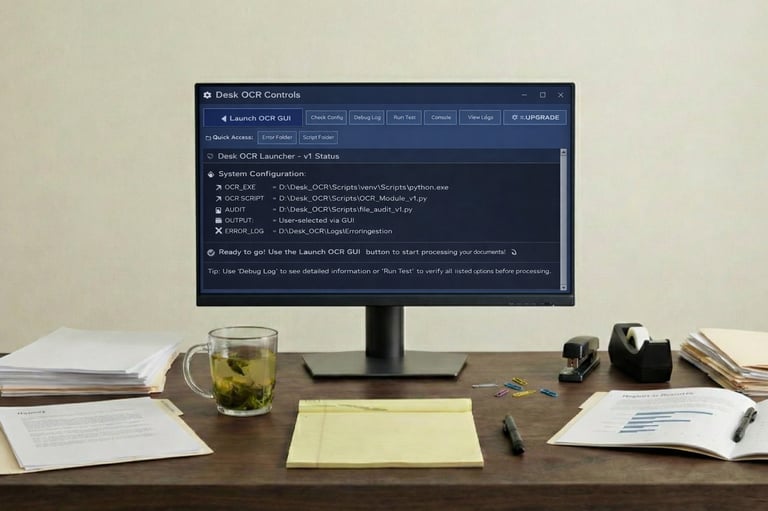
Context
MagVin Desk v1 began the day the Alienware arrived.
On July 11, 2025, I moved the project off the Mac and onto dedicated hardware for the first time. This was my first PC in over a decade, and it represented a fundamental shift in what the project could become. If MagVin Desk was going to evolve beyond experiments and prototypes, it needed a platform built for sustained compute, long-running processes, and architectural growth.
With the hardware constraints removed, a dangerous thought took hold: why not build the whole thing? So I did.
What I Built
The result was a single Python file containing 10,257 lines of code and 24 classes, each designed to cover a different aspect of the system. I implemented dual OCR engines using Tesseract as a baseline and PaddleOCR for multilingual documents, and I configured 143 YAML settings to control every conceivable behaviour. The interface was my first attempt at designing a GUI, and the output was Markdown files with YAML front matter, which would eventually feed into a local LLM setup running Llama 3.1 8B through Ollama.
The ambition was expansive: centralised document storage, OCR pipelines for extensive personal archives, consistent metadata, and a single environment where ingestion, processing, and review could coexist. For the first time, the project was optimising for capability on a device with real compute power.
What Changed
Once the foundation was in place, I kept building. The focus shifted from proving feasibility to extending capability. I explored additional ingestion paths for emails and Office documents, increased the complexity of the OCR pipelines, expanded metadata expectations to include EXIF and GPS data, and began experimenting with search, retrieval, and local reasoning in ways that started to overlap. Each addition addressed a real limitation, and each made sense when considered in isolation.
Collectively, however, they introduced a level of complexity that made the system hard to stabilise and even harder to understand. The Desk could do more, but reasoning about what it was doing began requiring more effort with every change.
What Worked
The move to dedicated hardware immediately raised the ceiling. I could now run workloads that earlier experiments could never sustain, and long-running jobs became feasible. The OCR core processed documents reliably, and the system finally felt like a coherent environment.
Even as complexity grew, the document pipeline became more capable. Edge cases surfaced early instead of remaining theoretical, and performance held up under load. The limits of the architecture became observable realities rather than assumptions. Most importantly, the project felt viable. The Desk was rough, but it was real.
What Broke
The same ambition that made v1 possible also made it unsustainable.
The monolithic architecture outgrew what I could maintain. GPU memory leaks caused long batches to crash without warning, and because resume capability was missing, interrupted jobs had to restart from the beginning. Output chaos followed: successful and failed files landed in the same flat folder, making it difficult to track what had actually worked. Silent fallbacks compounded the problem, since PaddleOCR would quietly degrade to Tesseract without notification, producing lower-quality results that looked identical to successes.
With zero tests in place, every change felt like a risk. The system worked, but only if everything worked. I was adding capability faster than I was adding understanding, and the gap between what I built and what I could confidently maintain was widening with every addition.
The Lesson
Simplicity beats comprehensiveness. Ambition without structure accelerates toward failure.
Attempting to cover every feature meant I could not maintain any of them reliably. The architecture was straining under decisions that made sense individually but, when aggregated, created instability. The Desk was becoming something I operated rather than something I controlled.
What Came Next
I understood the warning signs, but I wasn't ready to stop. The smarter choice would have been to pause and rebuild. Instead, I wanted to see how far the capability could stretch before the structure actually failed.
That decision led to further growth in version 2.
Phone +1-509-931-1685
© 2026. All rights reserved.
Email info@magvinlabs.com
Address 522 West Riverside Avenue
Spokane, WA 99201
Find MagVin on LinkedIn
MagVin Labs