
MagVin Desk v2: The 38% Mistake
I added two more OCR engines and grew the codebase 38% to over 14,000 lines, still in a single file. The Smart Content Router that bypassed OCR entirely for text-layer documents was genuinely useful, but the deeper failure was governance, not tooling. The limitation was clear: my own decision-making.
MAGVIN DESK
Lance
9/24/20253 min read
Context
Version 1 had pushed the system's scope as far as it could stretch without structure. The obvious next question was whether more capability would solve the problems that governance hadn't addressed. I decided to find out by adding engines: more OCR options, more language coverage, more ways to extract text from complex documents. The philosophy was simple. If one engine struggles, maybe four won't.
I understood the warning signs from V1, but I wasn't ready to stop. The architecture was straining, and the smarter choice would have been to pause and rebuild. Instead, I wanted to see how far the capability could be stretched before the structure failed.
What I Built
The codebase grew 38% to 14,193 lines, but it is still contained in a single monolithic Python file. I added EasyOCR for GPU-accelerated multilingual processing and TrOCR for transformer-based handwriting recognition, bringing the total engine count to four. The class structure expanded to 27, including three new components: an enhanced content router, a comprehensive metadata extractor, and a multi-language testing framework. I also implemented multi-engine fusion for the first time, allowing the system to combine results from different engines and vote on the best output. The 143 YAML configuration settings carried forward unchanged.
The Smart Content Router
The most helpful feature in V2 had nothing to do with OCR. I created a router that analysed incoming files and determined whether they already contained extractable text. Text-layer PDFs, Office documents, emails and plain-text formats could bypass the entire OCR pipeline. Direct extraction meant perfect accuracy and massive time savings. This single feature survived every subsequent version because it elegantly solved a real problem: the fastest OCR is the one you never have to run.
What Worked
Multi-language coverage improved substantially. Living as an expat since 2009 means I have years of contracts, rental agreements, and official documents in languages other than English, all of which need to be converted into searchable Markdown for the Desk to be comprehensive. The fusion approach proved viable, and comparing outputs from multiple engines surfaced quality issues that a single engine would have missed.
Edge cases appeared faster because I had more comparison points.
The Smart Content Router alone justified the version; on document sets with mixed file types, it dramatically reduced processing time while eliminating OCR errors on extractable files.
What Broke
PaddleOCR's DLL conflicts persisted. I spent hours debugging the same Windows startup errors that had plagued V1, and adding more engines introduced additional dependency conflicts. The monolithic architecture, already straining at 10,000 lines, became nearly unmanageable at 14,000. My output folders are filled with thousands of files, successes and failures mixed with no organisation. The system still couldn't resume interrupted batches, still had no tests, and still failed silently when engines returned unusable output. Every problem from V1 remained. The 38% growth just made them compound faster.
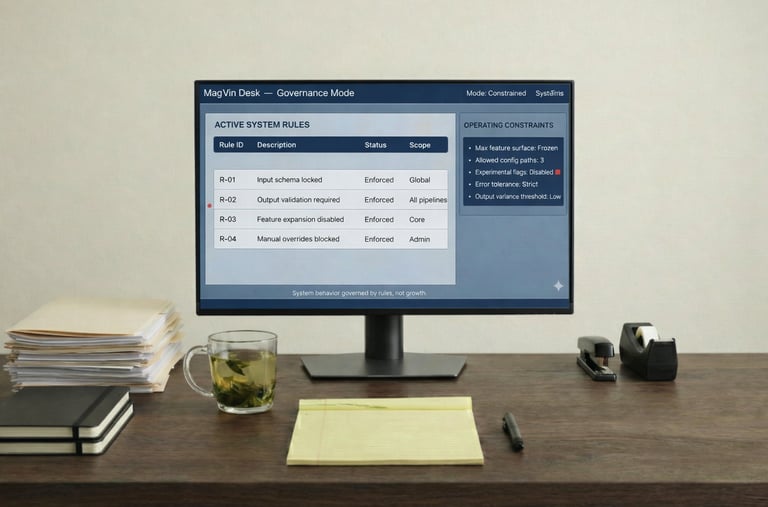
But the deeper failure was not technical. It was governance.
The scope of the Desk still had no hard constraints. Deferral criteria were absent. Stability lacked a shared definition beyond "it runs on my machine." I had justified every new idea in the moment, and lacking explicit rules to govern decisions, I had approved nearly all of them. My ability to reason about the system's behaviour was decreasing as complexity increased, and fixes increasingly risked breaking unrelated components.
The Desk continued to function, but I was losing track of how. The gap between capability and comprehension had grown too wide to ignore.
The Lesson
Architecture defines what expansion can sustain.
I had added genuine capabilities: the Smart Content Router, multi-engine fusion, and improved language support, but none of it could overcome the underlying structural weakness. Building more features on a fragile foundation doesn't strengthen the foundation; it increases the weight until something gives.
V2 forced me to confront a harder truth. Earlier failures could be attributed to tooling or platform limitations, but with capable hardware now in place, those explanations ring hollow. The limitation was clear: my own decision-making. And acknowledging that was uncomfortable but necessary.
What Came Next
V2 was archived. The accumulation of capability on top of architectural debt had reached its limit.
During that pause, I articulated principles that would govern everything going forward. These were not aspirations. They were constraints:
quality > speed
accuracy > speed
fidelity = paramount
At this point, the project needed better discipline, not more features. Without explicit rules and fixed assumptions, the same patterns would recur on a larger scale and at a higher cost. That outcome was both foreseeable and unacceptable.
The next version would require something I had been able to avoid until now: a complete rewrite focused on simplicity rather than expansion. That rewrite became V3.
Phone +1-509-931-1685
© 2026. All rights reserved.
Email info@magvinlabs.com
Address 522 West Riverside Avenue
Spokane, WA 99201
Find MagVin on LinkedIn
MagVin Labs