
MagVin Lab v2: The Quality Ceiling
NiceGUI solved the flickering problem in an afternoon: WebSockets pushed telemetry without full-page reloads. But the gauges rendered flat, the layout felt generic, and no amount of refinement would change that. The framework worked; it just was not good enough.
MAGVIN LAB
Lance
12/8/20252 min read
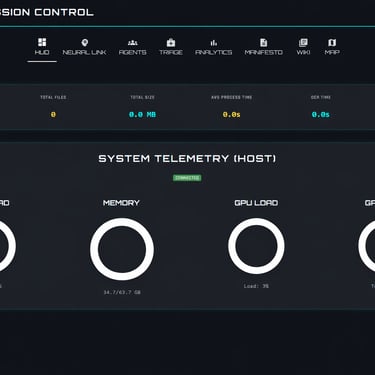
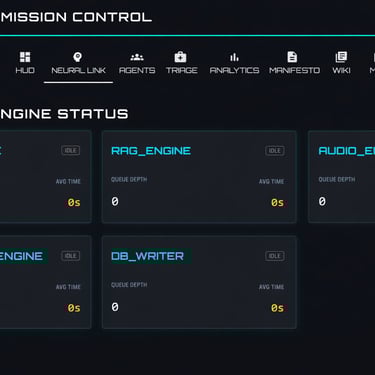
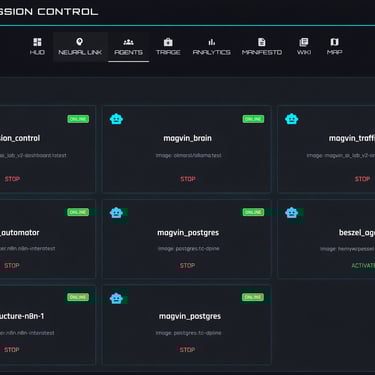
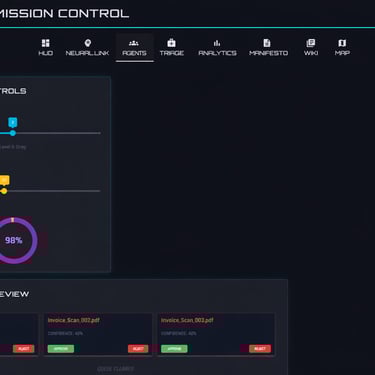
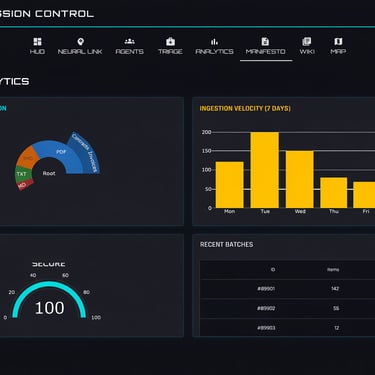
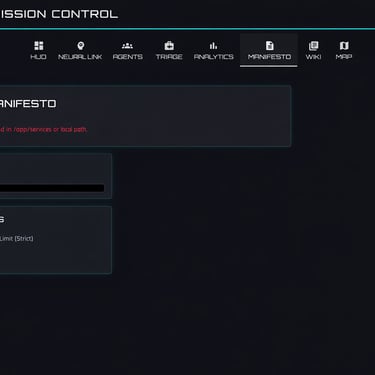
Screenshots from MagVin Lab v2
Context
Version 1 of the Lab ended with a clear verdict: Streamlit could handle the stack, but it could not handle real-time telemetry without flickering. The framework had reached a ceiling, and the interface needed to be rebuilt on a platform designed for continuous updates. NiceGUI promised exactly that.
NiceGUI uses WebSockets to push state changes to the browser without full-page reloads, which meant the live telemetry I required could finally work as intended. The circular gauges, the hardware HUD, and the agent status panels can all update every 2 seconds without tearing the screen apart. The technical case was straightforward, and I wanted to see if the framework could deliver.
What I Built
I scaffolded eight tabs in NiceGUI and attempted to carry the Alienware Cockpit aesthetic forward, applying Orbitron headers, Rajdhani body text and cyan accents against a dark background. The HUD displayed real-time CPU load, memory usage, GPU load, and GPU temperature via telemetry wired directly to the host. At the same time, Neural Link showed engine status cards, and the Agents tab listed Docker containers with activation controls. Triage, Analytics, Manifesto, Wiki, and Map tabs contained placeholder content ready for future wiring once the framework proved viable.
The technical test mattered most because I needed to confirm that telemetry would render smoothly, and it did. The gauges updated without flickering, and the WebSocket architecture worked exactly as advertised.
What I Saw
The framework solved the problem I asked it to solve: the interface updated cleanly, the data flowed correctly, and the flickering that had killed Streamlit simply did not appear. Unfortunately, the result still disappointed me.
Where I had built breathing, colour-shifting displays in Streamlit that responded to system state, the NiceGUI gauges rendered as plain white rings. The layout felt boxy and uniform, closer to an admin dashboard than the command centre I had envisioned, and a few hours of adjustments confirmed that this impression was not a matter of early roughness. NiceGUI was built for functional interfaces and rapid prototyping, which it accomplished well; it was not built for the aesthetic authority the system required.
It was good. It was not good enough.
Why I Stopped
The test answered its question within an afternoon: NiceGUI could wire into the backend and display telemetry without flickering, which meant the technical hypothesis held, but the quality hypothesis did not. I had a specific vision for how I wanted to interact with this system every day, and NiceGUI could not deliver that experience, regardless of how much refinement I applied.
Continuing would have meant settling for an interface I tolerated rather than one I trusted, and that was not acceptable.
The Lesson
Solving the technical problem revealed an entirely different issue. The framework that could wire into the backend could not deliver the interface I wanted to use, and recognising that distinction early saved weeks of misallocated effort. Quality is a first-order constraint.
What Came Next
The pivot to FastAPI and React began immediately, starting over with complete authority. React offered full control over rendering, while FastAPI provided explicit, inspectable endpoints for system state. That rebuild became MagVin Lab v3.0.
Phone +1-509-931-1685
© 2026. All rights reserved.
Email info@magvinlabs.com
Address 522 West Riverside Avenue
Spokane, WA 99201
Find MagVin on LinkedIn
MagVin Labs